Hive humidity affects mite reproduction
Don’t you love it when someone validates your opinions? Especially someone who knows something? Here’s what happened. Last week I wrote a post called Mitekeeping for everyone, in which I say that the most important thing a beekeeper can learn is the Varroa mite life cycle and how it relates to the honey bee life cycle.
Then, the very next day, I discovered an article in the new Bee Culture (October 2012, Volume 140, Issue 10, p. 22) called “Varroa Mite Reproductive Biology.” In it, Michigan State University bee researcher Zachary Huang writes, “The Varroa mite is currently the most severe pest of managed honey bees worldwide. Understanding the Varroa mite’s reproductive biology will therefore allow us to better manage this important pest.” Exactly right.
In the article Zachary explains many of the factors that affect mite reproduction and life cycle, including the brood caste, the age of the host larvae, details of the phoretic stage, the host species (Apis mellifera vs A. cerana), cell size, etc. But the thing that most caught my attention was a short paragraph on hive humidity.
According to the article, mite reproduction drops significantly when the relative humidity is high. In one study (Kraus and Velthuis, 1997) at 59-68% relative humidity, 53% of mites produced offspring, whereas at 79-85% relative humidity only 2% of the mites produced offspring. Zachary goes on to explain that, he too, has had experience with this phenomenon in his lab.
Right away I contacted Zachary to ask him if anything is known about how this works and whether it is wise for beekeepers to continue lowering hive humidity in the winter. I was really worried about this because hive moisture is my favorite “bad guy.”
He responded that 1) nothing is known about how high humidity affects Varroa reproduction and 2) it is still good to control hive humidity in winter for other reasons. And since there isn’t much brood being raised at that time, the effect on mite reproduction is probably minimal.
Okay, I can relax for the moment. But seriously, read the article. It is filled with tidbits that will improve your Varroa mite i.q. It certainly improved mine.
Rusty
HoneyBeeSuite
We are a group of micro farmers who welcome anyone who keeps animals or grows vegetables and fruit, or loves cooking! Who would like to come along to our meetings or events and share their experiences with others. You don't need to have lots of animals to be a "smallholder." Many people who grow vegetables, have some bees or maybe a couple of backyard chickens come along and enjoy the meetings and events as well.
East Essex Smallholders Chitchat Headline Animator
CONTACT EESG
Tuesday, 9 October 2012
UK Wool Week - 15-21st October 12
October
15th – 21st UK Wool Week
Wool School is a collaboration between Campaign for Wool partner retailers and fashion universities; to create special wool rich (minimum 80%) sweaters which are available in store as a limited item, the sale of which starting with Wool Week 2012.
In 2011, in support of regional and local activity and support for CFW – Love Wool UK attracted nearly 700 individual events coordinated by individuals and groups themselves. It is expected to increase in 2012. The concept is to build knowledge and enthusiasm for wool activities to raise the profile of wool and the CFW and use the opportunity to capitalize on the groundswell of information which is now a part of the wool experience.
More activities will be unveiled as we near the time.
http://www.campaignforwool.org/events/2012-event-details/#oct
Labels:
Wool activities October 12
Monday, 8 October 2012
Harvest Festival - Members Meeting - 23 October 2012 - The Bell, Purleigh
The Bell at Purleigh
Tuesday 23 October 2012
7.30pm for 8pm
Directions to The Bell, Purleigh:
| The Street Purleigh, Essex CM3 6QJ |
Join other members for a talk on growing produce - the farming year and the challenges it provides.
ALSOA Bread making Competition PRIZE to be won for "The best all round loaf" A class for own recipe or made from a packet ! (please specify which you wish to enter when registering) We would kindly ask that all loaves entered are donated for the bread and cheese supper. Please register your entry to the competition with helenmquinnell@btinternet.com FOLLOWED BY The Bread and cheese supper Suggested donation on the night of £1 If anyone has any wacky and wonderful homemade chutneys pickles they wish to bring along for everyone to try we would LOVE to taste them. AND FINALLY "Look what I grew" table If any member has any interestingly sized or shaped vegetable they grew on purpose or by mistake we would love to have a look at them! Bring them along and let us have a giggle! or if you have eaten them and only have a photo bring that instead. Please let Helen know if you are entering a 'loaf' for the Bread making competition or bringing anything else along - thanks! |
Labels:
bell,
bread,
bread competition,
cheese,
competition,
harvest festival 2012,
helen quinnell,
purleigh,
supper,
the bell,
what I grew
Chicken Vet update - respiratory Disease in Chickens
Chicken Vet talks about ........Respiratory Disease
One of the most common disease questions we get on our helpline and forum is “help my bird is showing signs of snicking, sneezing and coughing”. These birds can have a runny nose and foamy running eyes and in severe cases they can have swollen sinuses (swelling around the eyes), stop eating and in extreme cases die.
Stress will often cause these symptoms to appear and can be due to extremes of temperature and humidity, high stocking density, being transported, being taken to a show and new animals being introduced to an existing/established flock.
Antibiotic treatment is usually advised by your vet. It is commonly administered in water but in severely ill birds injections may be the best option.
Our advice:
Isolate birds from other healthy hens, give lots of TLC and give veterinary attention where necessary.
A simple blood test can determine which pathogens are involved. It is often the case that more than one is involved, the most common are:
-Mycoplasma Gallisepticum: a type of bacteria which can cause respiratory disease in poultry. Often associated with swollen sinuses, sneezing and foamy watery eyes. It can infect the oviduct thus altering egg shell colour and quality and thus it can be transferred via the egg to chicks. Once infected a chicken is infected for life although clinical signs will regress with time and treatment.
-Infectious Bronchitis (IB): IB is a coronavirus which causes sneezing, foamy eyes and swollen sinuses usually in young birds. However like Mycoplasma it can infect the oviduct again altering egg shell colour and quality but unlike Mycoplasma it doesn’t infect chicks via the egg.
-AvianRhinoTracheitis virus (ART): a pneumovirus which causes swollen heads, swollen sinuses, sneezing and in severe cases nervous signs.
-Infectious LaryngoTracheitis virus (ILT): a herpes virus that causes similar respiratory signs. ILT often leads to a plug of blood and mucus which can block the birds trachea (windpipe) leading to the bird choking to death. This virus like Myoplasma never goes away and can return during times of stress.
The pathogens above are mostly viruses which will not respond to antibiotics but these viruses often damage the respiratory system sufficiently to allow secondary bacteria such as E. coli and Pasteurella to cause infection.
Prevention:
-Minimise stress
-Ensure stocking density and ventilation are correct
-Buy in disease free birds from a reputable supplier
-Quarantine new birds for at least 3 weeks
-Consult your vet for antibiotic treatment.
-Aid speedy recovery with inclusion of Chicken Vet Multivits, Amino + or Beryl’s Friendly Bacteria.
For further help and advice visit www.chickenvet.co.uk
One of the most common disease questions we get on our helpline and forum is “help my bird is showing signs of snicking, sneezing and coughing”. These birds can have a runny nose and foamy running eyes and in severe cases they can have swollen sinuses (swelling around the eyes), stop eating and in extreme cases die.
Stress will often cause these symptoms to appear and can be due to extremes of temperature and humidity, high stocking density, being transported, being taken to a show and new animals being introduced to an existing/established flock.
Antibiotic treatment is usually advised by your vet. It is commonly administered in water but in severely ill birds injections may be the best option.
Our advice:
Isolate birds from other healthy hens, give lots of TLC and give veterinary attention where necessary.
A simple blood test can determine which pathogens are involved. It is often the case that more than one is involved, the most common are:
-Mycoplasma Gallisepticum: a type of bacteria which can cause respiratory disease in poultry. Often associated with swollen sinuses, sneezing and foamy watery eyes. It can infect the oviduct thus altering egg shell colour and quality and thus it can be transferred via the egg to chicks. Once infected a chicken is infected for life although clinical signs will regress with time and treatment.
-Infectious Bronchitis (IB): IB is a coronavirus which causes sneezing, foamy eyes and swollen sinuses usually in young birds. However like Mycoplasma it can infect the oviduct again altering egg shell colour and quality but unlike Mycoplasma it doesn’t infect chicks via the egg.
-AvianRhinoTracheitis virus (ART): a pneumovirus which causes swollen heads, swollen sinuses, sneezing and in severe cases nervous signs.
-Infectious LaryngoTracheitis virus (ILT): a herpes virus that causes similar respiratory signs. ILT often leads to a plug of blood and mucus which can block the birds trachea (windpipe) leading to the bird choking to death. This virus like Myoplasma never goes away and can return during times of stress.
The pathogens above are mostly viruses which will not respond to antibiotics but these viruses often damage the respiratory system sufficiently to allow secondary bacteria such as E. coli and Pasteurella to cause infection.
Prevention:
-Minimise stress
-Ensure stocking density and ventilation are correct
-Buy in disease free birds from a reputable supplier
-Quarantine new birds for at least 3 weeks
-Consult your vet for antibiotic treatment.
-Aid speedy recovery with inclusion of Chicken Vet Multivits, Amino + or Beryl’s Friendly Bacteria.
For further help and advice visit www.chickenvet.co.uk
Thursday, 4 October 2012
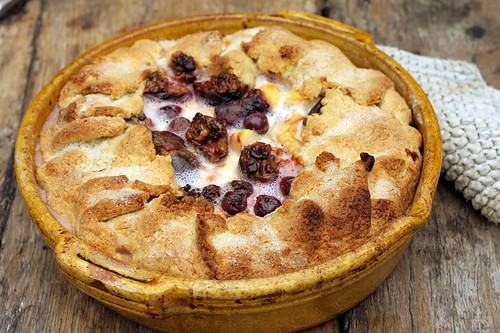
Harvest Tart receipe - recommended by gourmet Nick Elcombe of Jenkins Farm (here's hoping he will make one for a our Harvest Festival Meeting on 23 Oct)
Harvest TartOne 9- to 10-inch (23 -25 cm) tart
Recipe from Kate Hill, of Kitchen at CamontFor the dough2 3/4 cups (400 gr) flour
1 tablespoon sugar
pinch of salt
9 ounces (250 gr) unsalted butter, chilled
2 large eggs (total)
3 tablespoons water
For the filling2 1/4 pounds (1 kg) apples, peeled and cored
12 figs, halved
1 small bunch (2 to 4 ounces, 60 -120 grams) fresh grapes, stemmed
1/3 cup (65 gr) sugar, plus additional sugar for sprinkling
a big handful of whole walnuts
1 1/2 tablespoons Armagnac (or brandy, or 1 teaspoon vanilla extract)
1 cup (250 g) crème fraîche
1 large egg1. To make the dough, in a large mixing bowl, stir together the flour, sugar, and salt. Cut the butter into cubes and mix together with your hands or using a pastry blender until it’s in small pieces no larger than the size of corn kernels.2. Add one egg and the water, and mix until the dough holds together. Roll the dough out on a lightly floured surface until it’s about 18-inches (45 cm) round.Brush off any excess flour and fit into a 9- or 10-inch high-sided round baking dish or cake pan; the edges will overhang the sides quite a bit. (If using a springform pan, double wrap the outsides with foil to avoid leaks.)3. Beat the remaining egg in a small bowl with a fork, then brush the insides of the dough with the egg.4. Prepare the filling by slicing the apples into eighths. Mix them together with the figs, grapes, 1/3 cup (65 g) sugar, and Armagnac, then transfer the filling into the tart dough. Strew the walnuts over the top of the fruit.5. In a small bowl, mix together the crème fraîche with the egg and pour it over the fruit and nuts. Lift the edges of the dough and cover the fruit, then sprinkle a good amount additional sugar over the top of the dough.(When making tarts like this, I brush the dough with melted butter to help it stick.)6. Put the tart on a baking sheet and bake in a 425Fº (218ºC) oven for 55 minutes to 1 hour, until the top of the dough is browned and the fruit is cooked through, which you can verify by poking the center with a paring knife; when done, it should meet no resistance.(Note: During baking, the walnuts may darken, as shown. This is a rustic touch and typical. If you are concerned, you can drape the tart with foil if they become too dark for your taste.)7. Remove the tart from the oven and let cool down a bit before serving.
Serving: It might be hard to get a clean slice from this juicy tart, so feel free to serve slabs into bowls. Kate serves the tart with sweetened crème fraîche fortified with a shot of Armagnac or brandy. Vanilla Ice Cream or regular whipped cream are other possible accompaniments.
Labels:
apples,
armagnac,
harvest tart,
Jenkins Farm,
nick elcombe,
recipe of week,
sugar,
walnuts
Meatline Newsletter 1 October 2012
RETAIL SPECIALS TO 06/10/12
IMPORTANT !!! The email & Facebook specials are at even better prices than the in store special price. Make sure you quote this weeks word to ensure you get these amazing prices. This weeks word :- It’s
Pay attention because over the next few weeks these words will make a sentence or ditty and the first three customers in with the correct sentence will get a whopping 20% off of their bill on that day. So tell your friends to come and join the fun.
| |||||||||||||||||||||||||||
Labels:
buy local,
Jenkins Farm,
large blacks,
meatline,
offers,
pigs,
rare breeds,
stisted
Wednesday, 3 October 2012
Equine Infectious Anaemia
3 October 2012 - Defra has confirmed that a case of Equine Infectious Anaemia (EIA) has been detected in a horse in Cornwall. Further information from: www.defra.gov.uk/ahvla
Subscribe to:
Comments (Atom)