
East Essex Smallholders Chitchat Headline Animator

CONTACT EESG

To Contact EESG
Please Email:
Danielle.Perkins@yahoo.co.uk
or 07854595640

Friday, 28 March 2014

News from our Members

Such a lot to report, I have been trying all week to write a little bit.  I shall start with our most recent new. Tilly has calved! We have a beautiful Heiffer calf called Tulip! Born on Tuesday!

It wasnt a simple birth! We knew Tilly was in labour and had been checking her every half an hour on the cow cam. However in between checks Tulip had popped out no trouble at all. Although Tilly wasn't that keen on her, she was rather rough and flipped the poor baby across the barn with her horns. She also wouldn't let her feed. With the help of great friends and family, time and persistence all is now well. I checked the cow cam at 1.30am this morning and Tulip was feeding, followed by a playful whoop whoop session around the barn. We are thrilled. 

I think Tulip will be staying, although our friend Nigel says she should be steak and chips!! We aren't sure.

Now for all our other news:
Dennis left us on Friday, all went well he loaded well and had a stress free journey. I do feel awful about it, especially when I returned to the abbatoir to collect the offal. I just keep reminding myself why we raise our animals, what a wonderful life they have had and how we are eating such great meat that has been raised with love, without the added medicines that commercial meat has. Never the less it was still very hard. The carcass hasn't come home this time, he has gone to our friends butchers shop to hang until 16th April when we shall butcher the carcass with the help of Darren the butcher.

I decided that I was going to give it a go, cooking the tongue, last years went straight in the freezer and that's where it has stayed. I boiled it 4 hours with garlic, black pepper, carrots and onions. It was really nice. I won't be so scared next time. The lungs have been boiled up for the dogs to supplement their  food over the next week. 

Grandad and I collected the new pigs at 7am on Saturday morning, no weekend lay in for us. The pigs were rather large, they have had plenty of food, Gareth has called one of them Hector, he has massive shoulders! We now have ten oxford sandy and black piggies. So if anyone is looking to purchase free range rare breed pork, we have plenty! 

Well I'm sitting drinking tea, watching lambing live, I can't wait until lambing! 

I hope to check in over the weekend, with more news of how our little tulip is getting on!


Tuesday, 11 March 2014

Coming soon ...................Bottle Fed Lambs for sale


Coming soon ...................Bottle Fed Lambs for sale


I have received an email from the Speakman’s they have had their flock of Easy Care ewes scanned and they are expecting an incredible 19 TRIPLETS.
Lambing starts around 1st April so there will be some bottle fed lambs available from around that time.
They will be £20 each and trained onto the bottle.

If you are interested please call Kit 07850 997688

Here is some information about the Easy Care breed of sheep from The Easy Care Sheep Society or click the link below.

Easy Care is a revolutionary breed of sheep which requires minimal shepherding and veterinary care, sheds its wool in the summer, does not need shearing and yet offers excellent meat yields and lambing ratios. The breed is now well established in Britain and abroad and is proving extremely popular and successful with breeders in today's farming environment.

Monday, 10 March 2014

9 Home Remedies for Dry Skin


Feb052014
 
9 Home Remedies for Dry Skin - Help relieve winter dry skin and eczema, relieve itching and cracking. Tips for avoiding dry skin year round.
This winter has been cold, cold, cold here in the upper Midwest!  Along with cold temps comes dry air, and with dry air often comes dry skin and chapped lips.  I’ve pulled together 9 home remedies for dry skin, along with tips for avoiding dry skin year round.  From coconut oil to backyard weeds, we’ll help relieve winter dry skin and eczema and sooth itching and cracking.

Home Remedy for Dry Skin #1 – Coconut Oil

Coconut oil is a much loved moisturizer for many.  It may work best when applied at bedtime and allowed to soak in overnight. Eating it may be even more helpful.  My personal favorite is Nutiva coconut oil, which tastes like fresh coconut.  (If you buy Nutiva products through my site, I receive an affiliate payment at no extra cost to you.  Thank you!)  Some people do find coconut oil to be comedogenic (pore clogging) – others do not.  (I use it daily and do not have any problems.)  Some find that it wears off too quickly, which is why I like to use option #2 – hard lotion bars.

Home Remedy for Dry Skin #2 – Hard Lotion Bars

A couple of times per year, I mix up a batch of hard lotion bars.  Hard lotion bars are a moisturizer that is hard at room temperature, but melts when it is warmed by your body heat.  To use, you simply hold the bar in your hands to warm it, or rub against the area that the want to treat.  These bars have a great shelf life and don’t require refrigeration like some homemade creams and lotions.  They’re also great to slip into a baggie and pop into your purse, because they won’t spring a leak like a lotion bottle might.  Beeswax and cocoa butter team up to trap moisture naturally without harsh chemicals, and combine with olive oil or coconut oil to moisturize your skin.  You can check out the recipe in the post “Super Easy Hard Lotion Bars“.  This recipe also makes a great lip balm for dry, chapped lips.  If you use cocoa butter, it smells like chocolate!  :-)

Home Remedy for Dry Skin #3 – Birch Tea

Birch tea is recommend in Backyard Medicine for the relief of skin conditions such as eczema and herpes.  The tea may be made using fresh or dry birch leaves.  To make the tea, cover four of five birch leaves with one cup of boiling water.  Steep for five to ten minutes.  For eczema, drink one cup of tea three to four times per day and apply the tea as a compress to the affected area.  To make a compress, dip a soft cloth into the warm or cooled (not boiling) tea and apply to the skin.

Home Remedy for Dry Skin #4 – Dandelion Leaf

America’s most hated lawn weed is like a mini-pharmacy in flower form.  Dandelion leaf is suggested for an herbal bath in the book Dandelion Medicine.  The author states that this bath is good for eczema and dry, oil, or itchy skin.  As a detoxifying agent, it may also by helpful to those who are trying to lose weight and those with yeast or fungal infections.
All you need is:
  • 1 pint of water
  • 2 heaping teaspoons of dried dandelion leaves - or – 1 handful of fresh dandelion leaves
Simply bring your water to a boil, then pour it over your leaves.  Cover (to contain volatile compounds) and let steep for 30 minutes.  Strain out the leaves and add the tea to a warm (not hot) bath.  Soak until the bath cools, or as long as you like.  If you don’t have dandelion leaf available, you can purchase it online at Mountain Rose Herbs or through other herbal sources.  (If you purchase through MRH via my site, I receive an affiliate payment.  Thank you!)

Home Remedy for Dry Skin #5 – Oatmeal Bath

There are several different options for using the soothing, nourishing powers of Avena sativa (oats) to your bath.  You can buy a premade product like Aveeno Soothing Bath Treatment or soap.  You can bundle up a handful oatmeal in a mesh bag and hang it in the stream of your bath water water (add some chamomile for extra soothing).  Squeeze the bag gently to release even more of the soothing oat milk.  Another option is to finely grind your oatmeal in a blender or food processor and sprinkle directly into the bath water.  Oatmeal may also be combined with milk (2 cups per bath) or baking soda (1 cup per bath).

Home Remedy for Dry Skin #6 – Herbal Bath

Adapted from 1001 Natural Remedies “Herbal Bath for Dry Skin”
Use 2 Tablespoons Each:
  • Comfrey Leaf
  • Marshmallow Root
  • Rose Petals
  • Chamomile
Place the dried herbs in a double layer of cheesecloth or mesh bag and place in the bathtub while it is filling.  Comfrey and marshmallow help soften dry skin, while rose petals and chamomile sooth and add a lovely fragrance.

Home Remedy for Dry Skin #7 – Vanilla Body Cream

This simple 4 ingredient body cream goes together in a flash in the food processor and keeps for around 6 months in the fridge.
Simply blend:
  • 2 tablespoons shea butter
  • 2 tablespoons virgin coconut oil
  • 4 tablespoons sweet almond oil
  • 1/2 teaspoon pure vanilla absolute oil
Store in a dark glass jar.  Makes about 4 ounces.

Home Remedy for Dry Skin #8 – Tallow Balm

Grass fed beef tallow is high in micronutrients that nourish skin, and can be made into a silky skin cream when combined with olive oil and a skin soothing essential oil.  Check out the post “Nourishing Tallow Balm” on GNOWFGLINS for the recipe and instructions.

Home Remedy for Dry Skin #9 – Glycerin

Two users on Earth Clinic recommend glycerin for dry skin.  One applies it mixed half and half with water, the other applies it full strength.  They suggest applying at bedtime and letting it soak in overnight.

Tips for Avoiding Dry Skin

Drink Plenty of Liquid – avoid sugary sodas, juices and caffeine, which may make skin conditions worse.  Look to water, herbal teas, and water kefir for hydration.  Infuse some fruit or add a splash of citrus or a sprig of mint to make plain water more appealing.
Eat Healthy Fats – Fats are essential for our health and well-being.  They help hold moisture in our skin, keeping it supple and soft.  Choose your fats wisely.  Avoid damaged fats such as hydrogenated oils, interesterified fats, and liquid vegetable oils such as corn, soy and canola (most of these are chemically processed and genetically modified).  Look for fats that are naturally solid at room temperature for cooking, such as butter, coconut oil, sustainably harvested palm oil, lard, tallow and poultry fat.  for non-heated applications, use extra virgin olive oil, or flaxseed or walnut oil.  Keep the flaxseed and walnut oils in the fridge, as they will go rancid quickly.  Fish oil and cod liver oil are also good.
Keep Warm, Not Hot – Hot showers, although they may feel great, will dry out winter skin even more.  Stick to warm or cool water.
Wash Less and Use Gentler Cleaners – I’m not talking about going completely “campy”, but consider showering less frequently and only using soap on teh stinky spots.  I’m guessing that most of us do not have elbows that require a heavy duty soapy scrubbing.  Opt for milder soaps and cleansers.  Soap acts as a surfactant, breaking up and washing away dirt, grime and oils – including our natural skin oils.  Many cleansers/soaps on the market are also filled with a cocktail of chemical fragrances and other questionable ingredients.  Keep it simple and keep it as natural as possible.  You may even want to consider going “no poo” or making your own soap.
I hope you find this post useful.  Please Pin, Share, Stumble or otherwise pass this post along if you like it.  Happy readers are our best advertising!
You may also enjoy the other posts in our Home Remedies Series.

Home Farmer


Facebook icon Twitter icon Forward icon

How to Build this Wooden Storage Shed...
Build this neat 'tall-boy' shed to keep all your recycling boxes (or anything else) handy, but out of site. To see how to build it click here.

Make Your Own Dishwasher Tablets...
You will need:
1 cup lemon juice
1 cup washing crystals
1 cup baking powder
1 cup salt
Put it all into one big bowl, and I mean BIG, otherwise you'll be clearing it up for ages! Once the foaming stops and it's all mixed together, place it in ice cube trays (half fill up the cavities) then let them set overnight. Then pop them out and let them dry out completely... and bingo!


Win a Pair of funky backdoorshoes...
It's muddy, it's raining, you only want to nip out and seal in the chicks for the night - hardly worth putting your shoes back on for - Cue *backdoorshoes. We've had our eye on these for ages, and  now they are offering the Chilli patterned ones in size 13 - perfect for our big-footed, curry-addicted editor - it's even better.  CHECK OUT THIS DISCOUNT - GET 10% OFF A PAIR. Go towww.backdoorshoes.co.uk and put in the promotion code HOMEFARMER10%DISC
We have 5 pairs up for grabs. To WIN one of them visitwww.backdoorshoes.co.uk and list 4 of the patterns the shoes come in. Send your answer to ruth@homefarmer.co.uk, marking the email BACKDOORSHOES, together with your name, address, preferred pattern and shoe size. The closing date is Thursday 27th Feb.
*backdoorshoes is the registered name.

Next Issue Due in Soon...
The page proofs are coming through look thick and fast, and as usual spot on. Dot Tyne's written a thought provoking article on getting through the hungry gap, Ben Crosby continues charting his journey towards creating a low-impact and self-sustaining plot, and John Harrison goes out to restore soil on the plot after sustained and heavy flooding.
On the livestock side Heidi Sands looks at how to care for domestic farm animals up to the moment of death and Terry Beebe considers what are the best laying chickens and how to mazimise production.
Better Butter Making will inspire anyone wanting to switch from marg to the real stuff, and our 'what to do with the left over buttermilk' recipes are truly delicious - especially the Peanut Butter Cookies.

Monday, 3 March 2014

How To Plant Potatoes


How To Plant Potatoes
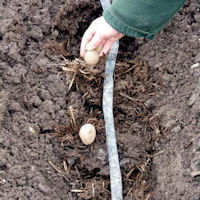

How To Plant PotatoesOnce you have bought your seed potatoes and finished chitting/sprouting them, time has come to plant them out. So, how do you plant potatoes? Well – the answer to that question is not as straight forward as it might seem, simply because there are a number of variables to take into account, such as where do you plant them (vegetable plot, raised beds and containers), what kind of potatoes are they (earlies/maincrop) – and so on. Hopefully you will find an answer to suit your needs below.
Planting Potatoes In A Garden/Allotment/Vegetable Plot
When planting potatoes in a vegetable plot in your garden or allotment, you will usually be planting straight into the soil. While potatoes will grow in practcally any kind of soil, you’ll get by far the best result in a fine/loose garden soil with plenty of organic matter, such as well rotted farm yard manure in it.
Also, to avoid potato diseases, you should never grow potatoes in the same spot within 2-3 years. In stead, grow plants from a different plant family, such as cabbages or peas/beans. You can read more about crop rotation here (opens in new window).
In a garden setting you’d usually grow your potatoes in rows. The spacing between the rows and the tubers/seed potatoes can be seen on this drawing:How To Plant Potatoes
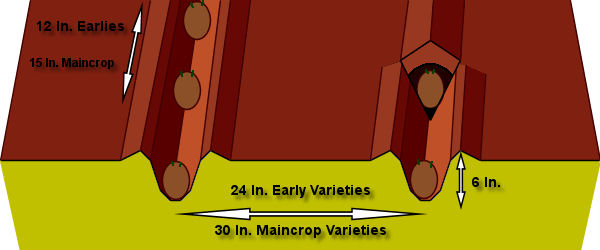
Dig a trench, approximately 4-6 inches (10-15cm) deep, and put in your seed potatoes. Cover the seed potatoes back over with soil, to create a low ridge, using a rake. If your soil isn’t fine/crumbly, you may want to cover the seed potatoes with a multi purpose compost or well rotted farm yard manure, before raking the soil back to form the ridge.
Planting Potatoes In Raised Beds
The ‘rules’ for planting potatoes in raised beds are pretty much the same as for planting straight into the soil. Only difference is that in raised beds you’ve got a chance of growing your potatoes in fresh soil/compost.
Again, you shouldn’t be planting potaoes in raised beds where potaoes have been grown in the last 2-3 years, due to the risk of soil borne diseases, unless you have emptied the raised bed of all soil and replaced it with fresh compost before planting.
Another thing you can do is to plant in holes rather than thenches, and then use a mix of fresh compost/well rotted organic matter to ‘earth up’ round the plants while they’re growing.
How To Plant Potatoes In Containers
If growing space is an issue, and you chose to grow your seed potatoes in containers in your yard, start by putting compost mixed with well rotted manure in the container, until 1/3 full. Put 4-6 inches of soil on top. Once shoots start to appear, keep covering with compost until the container is full, and leave to grow. Check out the section on how to grow potatoes in containers.
- See more at: 
http://how-to-grow-potatoes.co.uk/how-to-grow-potatoes/how-to-plant-potatoes/#sthash.huIIw26K.dpuf

Lambing Kit

lambing_equipment_list