


We are a group of micro farmers who welcome anyone who keeps animals or grows vegetables and fruit, or loves cooking! Who would like to come along to our meetings or events and share their experiences with others. You don't need to have lots of animals to be a "smallholder." Many people who grow vegetables, have some bees or maybe a couple of backyard chickens come along and enjoy the meetings and events as well.
Showing posts with label east essex smallholders group. Show all posts
Showing posts with label east essex smallholders group. Show all posts
Friday, 15 February 2013
How to Hatch Eggs
How to Hatch Eggs
Before you start
Before you incubate and hatch chicks, you should remember that you will end up with a ratio of half male and half female chicks. Unless you are hatching an autosexing breed (where markings or colour of the chicks are different colours) or have crossed two birds that give a sex-linked chick (again, different down colour or markings) then you will need to think ahead to when the young growers can be sexed around 8 weeks of age and consider what you will do with the excess of male birds. Sadly, they are very hard to re-home, everyone has the same problem: too many boys.Choice of incubator
 Pin It
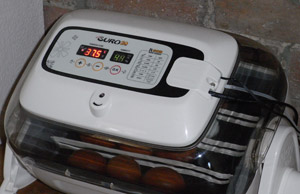
The R-Com Suro is a forced air incubator that controls both temperature and humidity.
Incubating Chickens Eggs
Chickens eggs have a 21 day incubation period (isn’t that amazing? Egg to chick in just 3 weeks!) and require a constant temperature of 37.5°C. Eggs will start to produce their own heat in the latter stages of development but the incubator thermostat takes care of this, keeping the temperature the same throughout the incubation period. Humidity should ideally be between 45 and 50%. Eggs need turning regularly by 180 degrees and you will need to do this yourself if the incubator doesn’t have an automatic turning mechanism. Expect 50% to 75% of your eggs to hatch, not all eggs will be fertile.Hatching Eggs
Eggs need to be fertile so a cockerel needs to be running with the hens for a few weeks before eggs are taken for hatching. If you have a cockerel, you can collect your own hatching eggs from your chickens. Try to pick good looking ‘egg shaped’ eggs, this will help the chicks form and hatch correctly as mother nature intended. Keep nest boxes clean and don’t set any soiled eggs. If you don’t have a cockerel or would like a different breed, there are many hatching eggs for sale online on sites such as eBay but keep in mind that just about anyone and everyone sells eggs so birds vary in quality between sellers. Hatching eggs travelling through the postal system can be damaged internally and either not develop or die before they hatch. These are often called dead in shell.Incubation tips:
- Before you put your eggs into any incubator, make sure it has been sterilised with an incubation disinfectant (or as a minimum warm soap and water if you don’t have this). This will kill bacteria that multiply rapidly in the warm temperature of the incubator.
- Plug in your incubator and make sure the temperature is steady at 37.5°C. Always leave it to run overnight to settle before putting eggs in.
- Keep water reservoirs topped up so that adequate humidity can be maintained at all times.
- Candle eggs before putting them into the incubator. Cracked or damaged eggs do not hatch and should be removed after candling (see below for more information on candling).
Candling Eggs
 Pin It
Candling an egg in the dark using a special candling torch. Blood vessels and the embryo can be clearly seen after a week.
The Air Sack
An Air Sack is formed at the broad end of the egg shortly after an egg is laid. There is a membrane between this and where the chick is developing. When candling periodically through the incubation period, this is the best method of judging normal development and you will see this increase in size up until the point that the chick breaks through into this air sack.The Hatch
- A chick will usually ‘pip’ the shell a few hours after breaking into the air sack so she can breathe but a full hatch can take 12 or more hours from this point so be patient.
- If humidity has been set too high during the incubation period, the chick may pip the shell underneath the shell and drown in the fluids before he can get his beak out of the shell.
- If the humidity has been too low, the air sack will be too large and the chick will be under-developed and may become stuck to the shell, too weak to break free.
And finally…
- Do not remove hatched chicks until they are fully dried out. Chicks do not need to eat for 24 hours. This is why they can be shipped around commercially as ‘day old chicks’.
Source: http://keeping-chickens.me.uk/chickens/how-to-hatch-eggs
Thursday, 17 January 2013
Sheep - Things to do this Month - January
The Smallholder Series is a fantastic resource for all Smallholders.
They produce a things to do monthly list: Here is January.http://www.smallholderseries.co.uk/index.php?option=com_content&view=featured&Itemid=233
*****************************************************************************************
Sheep - Things to do this Month - January
SHEEP – for a March/April lambing flock:
 Now that the ram’s work is done for the year and has left the ewes (pregnant, we hope!), check him over paying particular attention to his feet, any areas where the harness may have chafed, and condition. If he’s lost condition, which is likely, feed him your best hay and an appropriate amount of hard feed, if necessary – but remember, rams can suffer from urinary calculi if fed concentrates over a prolonged period. If you look after your ram now, he will do a good job for years to come.
- If you’re planning to scan the ewes, book the scanning operator if you haven’t done so already, and get organised: think about your handling system, aim to reduce stress for the ewes while making sure of a steady flow to the scanner. Scanning will tell you whether the ewe is pregnant, and whether she’s expecting a single, or multiple lambs – you can then feed appropriately to keep her at the ideal body condition score (3 for lowland ewes, 2.5 for hill and upland ewes) throughout her pregnancy.
- During early pregnancy, the ewes shouldn’t become too fat (see Specialist Sheep Vet, Chris Lewis’ article on Management from Tupping to Lambing) – so check their body condition regularly (Refer to Programme 2, “Managing Your Flock for Peak Health”, or look on our You-Tube channel for a demonstration of how to do this).
- Specialist sheep vet, Agnes Winter, has written an article for The Smallholder Series on The Importance Of Monitoring Body Condition through the winter, a vital element in producing healthy lambs next spring.
- If you’re feeding hay – a must in bad weather if the ground is frozen – they will get used to you going into their field every day, which means that if you need to treat any it will be less stressful for them.
- Think about housing for indoor lambing flocks – how well did your arrangement work last year? Can it be improved? Ensure there is good ventilation at head height to prevent respiratory disease, but try to avoid draughts at ground level.
- Calculate how much feed you’ll need for the 8 week period running up to lambing, and for 8 weeks after – (See our article, “Nutritional Management of the Ewe in Late Pregnancy”), and ask your feed merchant for a bulk discount!
- Continue to be vigilant for signs of liver fluke, especially if your sheep graze wet pastures (which includes most grazing after this year’s record rainfall) – any sudden loss of condition or unexplained death should be investigated. As winter progresses, so does the disease; cold weather (<10oC) will arrest further snail eggs being laid, so watch for symptoms of sub-acute disease, which include lethargy, anaemia (identified by pale mucous membranes), poor body condition, poor fleece quality and reduced grazing. Chronic fascioliasis, the next stage of the disease, can be detected in faecal samples; acute and sub-acute disease is diagnosed though blood samples that will show raised liver enzymes, and should be treated strategically in line with your Flock Health Plan. Choose the right treatment for each stage of the disease, as not all flukicides will treat all stages of disease. For a complete explanation of the complex lifecycle and treatment of this disease, (click here) to watch a video presented by Michaela Strachan.
- Scab continues to be a serious problem in many parts of the country, so watch out for itchy sheep and if you spot a sheep rubbing itself, ask your vet to take skin scrapings to confirm the diagnosis: if positive treat the whole flock immediately, not just the affected animal as scab is highly contagious. The best way to avoid scab is to observe strict bio-security for your flock: quarantine all incoming animals and ask your vet to test if you have any itchy sheep, and maintain double fencing between your flock and neighbours’ – remember the old adage: “A sheep’s worst enemy is a another sheep”.
Friday, 4 January 2013
Game Terrine
Game Terrine
Kindly Supplied by Toni Mutton
Ingredients
- selection of lean game meat, about 1kg/2¼lb in all, which could include: pheasant, pigeon, duck or other wild fowl, rabbit, hare, venison (from the leg or fillet)
- oil or fat, for frying
For the forcemeat
- 500g/1lb2oz sausage meat (half sausage, half minced game)
- livers from all the game, finely chopped
- 2 handfuls fresh white breadcrumbs (may need a little more)
- 1 egg
- 3 tbsp parsley, finely chopped
- few sprigs of thyme, leaves removed and chopped (I have used dried thyme)
- 5-6 juniper berries, crushed in pestle and mortar
- 2 cloves garlic, finely chopped
- splash of brandy
- splash of red wine
- salt and pepper
To line the dish
- 300g/10½oz streaky bacon, flattened with the back of a knife
Preparation method
- In a large mixing bowl combine the sausage meat and the chopped livers from the game.
- Next add the breadcrumbs, egg, parsley, thyme, juniper berries and garlic. Then the wine and brandy, season with the salt and pepper and mix everything together thoroughly, preferably with your hands.
- Cut the game meat into roughly same-size strips, about 2 fingers thick.
- In a heavy-based frying pan heat the fat or oil and fry the game pieces for 2 minutes until nicely browned.
- Line a loaf tin or ceramic terrine dish with the stretched rashers of streaky bacon. Add a layer of forcemeat followed by a layer of game meat, then a layer of forcemeat followed by another layer of game meat. However many layers you make (I usually go for three) be sure to finish with a layer of the forcemeat.
- Fold the exposed strips of bacon over the top of the terrine and cover well with kitchen foil. If your terrine dish has a lid on it so much the better.
- Place the terrine dish in a roasting tin half-filled with hot water. Cook in the oven at 160C/325F/Gas 3 for approximately 1½-2 hours. Test with a skewer to see if it is cooked, if the skewer does not come out of the terrine piping hot then it is not ready.
- For the best possible texture and easy slicing, your terrine should be pressed as it cools. I usually use a brick. Leave the terrine until completely cold for several hours or overnight.
- To serve the terrine, slice it thickly with a very sharp knife, put on a plate with a small salad of lightly dressed green leaves and a blob of good fruit chutney. Serve with hot toast.

Please do try this, its a lovely recipe! and a must before the end of the game season.
Tuesday, 18 December 2012
The perfect guide to cooking your Christmas Turkey
For the best instructions on how to cook your turkey take a look:
http://www.kellyturkeys.co.uk/kellybronze-turkeys-chickens-default.aspx?m=10&mi=98

http://www.kellyturkeys.co.uk/kellybronze-turkeys-chickens-default.aspx?m=10&mi=98
Monday, 17 December 2012
What would you like to see from East Essex Smallholders Group?
We are currently planning the 2013 program of Events for East Essex Smallholders Group.
Please tell us what you want!
Who would you like to see as Guest Speakers?
Where would you like to visit?
What courses would you like the group to run?
What competitions do you think we should run?
Currently the blog has has over 50 visits per day.
What can we do to keep you interested in visiting the Blog?
What posts do you like to see of the blog?
More recipes?
More useful Websites?
Take five minutes with a cup of tea, and email me your thoughts: Danielle.Perkins@Yahoo.co.uk
Please tell us what you want!
Who would you like to see as Guest Speakers?
Where would you like to visit?
What courses would you like the group to run?
What competitions do you think we should run?
Currently the blog has has over 50 visits per day.
What can we do to keep you interested in visiting the Blog?
What posts do you like to see of the blog?
More recipes?
More useful Websites?
Take five minutes with a cup of tea, and email me your thoughts: Danielle.Perkins@Yahoo.co.uk
Wednesday, 21 November 2012
Chicken owning fad lauded by Jamie Oliver 'hurting birds'
Chicken owning fad lauded by Jamie Oliver 'hurting birds'
It is a middle-class trend championed by celebrities including Jamie Oliver and Billie Piper, but urban households who keep chickens at home could be putting a bird’s welfare at risk.
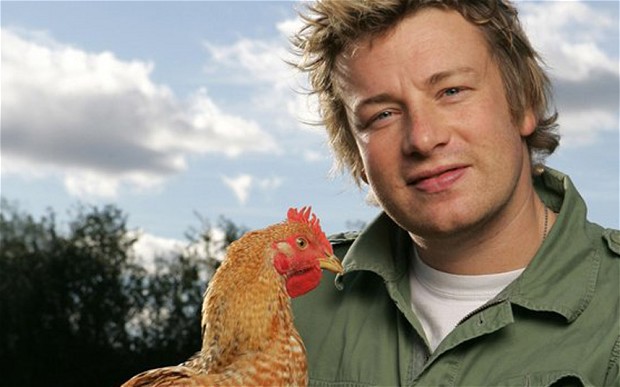
An estimated 500,000 British households now keep chickens in their backyards including Jamie Oliver, the chef. Photo: Channel 4
11:45AM GMT 19 Nov 2012
A new study has found that backyard chicken-keepers have a lack of disease knowledge and insufficient awareness of laws needed to breed animals at home. Researchers concluded that owners consequently rarely vaccinate their animals, which could have serious implications on disease control and animal welfare.
The Royal Veterinary College study found there was a low level of awareness in and around the Greater London area of diseases that could negatively affect birds' welfare.
According to its research, households have little knowledge of such diseases as Marek's.
Marek´s disease (MD), which is caused by a herpes virus, can result in death in extreme cases and is a problem in many household flocks, particularly those that
It causes changes in a bird’s nerves and may cause tumours in major internal organs, such as its ovary, liver, kidney, heart and spleen.
Vets also surveyed backyard spaces and while chickens were generally housed in good living conditions up to three in four did not comply with government regulations on using kitchen waste as feed.
Since 2001 it has been illegal to feed such waste to farmed animals in Britain because some disease agents can survive in food products and facilitate the spread of disease.
Feeding chickens with food such as chicken meat and eggs can spread viruses such as the Newcastle Disease, which can preserve its infection for weeks.
The research, published in this month's British Poultry Science journal, also found lapses in biosecurity, with humans frequently allowed to access the birds.
Furthermore, nearly half of the flock owners would not seek veterinary help in cases of illness in their chickens. Up to four in 10 owners surveyed stated they would dispose of dead birds by burying them in their gardens.
Guidelines issued by the Department for Environment, Food and Rural Affairs (Defra) states that they should be incinerated to prevent disease spread through groundwater and wild species.
A total of 65 backyard chicken "flock-keepers" were recruited between May and July 2010 through a series of advertisements on websites, at City farms, veterinary practices and pet feed stores.
They were given questionnaires asking for keepers’ and flocks’ characteristics, housing and husbandry practices and owners’ knowledge of health problems in chickens and diseases. Welfare assessments of flocks were also undertaken.
Iveta Karabozhilova, the report's co-author, said today the study highlighted an alarming lack of communication between authorities and chicken keepers.
“Even though evidence from our study shows that flock owners provide enriched living conditions to the chickens, they ought to realise that their pets are a farmed species and are subjected to regulations," she said.
"They need to expand their knowledge beyond the diseases for which there has been much publicity [such as] Salmonellosis and Avian Influenza, and be aware of the fact that some diseases must be reported."
An estimated 500,000 British households now keep chickens in their backyards including celebrities Oliver, the chef, and Piper, the actress.
Other celebrities also reported who have followed the trend include from Jeremy Clarkson, who has complained that his birds peck him, Liz Hurley, the model and “battery-chicken rescuers” Pam Ayres, the broadcaster and writer, Amanda Holden, the television presenter and Sadie Frost, the actress.
The Prince of Wales is patron of The Poultry Club and the Duchess of Devonshire is an “enthusiastic poultry keeper”.
Barry Thorp, a poultry veterinarian in Scotland, said the rise in people keeping backyard chickens increased the possibility of disease spreading.
"Because they are farm livestock, they require a different approach to pet animals " he said.
"It is not necessarily that they're badly treated, but a lack of education and awareness by those who buy them certainly make them more vulnerable to disease and therefore pose a bigger threat of spreading it.”
From the Telegraph:
Sunday, 18 November 2012
EESG Calender 2013

Don't forget to order your copy of the EESG 2013 Calender.
A4 spiral bound with 12 beautiful glossy photos provided by EESG members one for each month, also a space for each day to write those important dates.
The Calendar will make a super Christmas present and comes with an A4 envelope for easy posting and only £8.00 each
The Calendar will be on sale at the next EESG meeting on 20th November and The Christmas Quiz on 8th December.
We are also offering a Purchase and Post Service for just an extra £2.00 to order your copy please contact agnesmaevaharris@hotmail.co.uk
Subscribe to:
Posts (Atom)